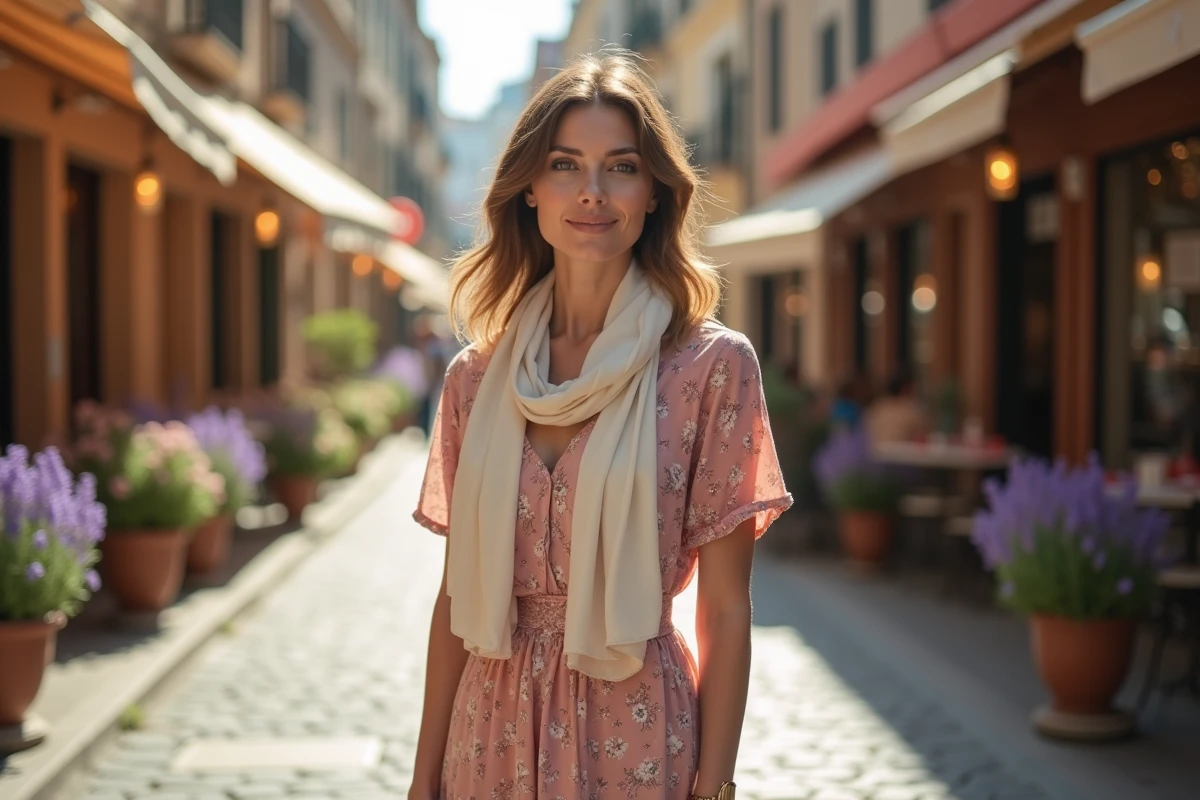
A scarf tied around the neck alters the line of a dress by creating a focal point on the upper bust. This styling principle is based on a simple visual mechanism: the eye is drawn to the area where the contrast of texture or color is most pronounced. Mastering this placement allows for transforming a solid dress into a structured outfit without adding unnecessary volume.
Scarf material and neckline type: the technical duo to address first
Before choosing a knot or folding style, the compatibility between the scarf material and the dress neckline determines the final effect. Silk glides over round collars and does not hold well without a tight knot, while it lays naturally on a V-neckline where gravity keeps it in place.
Cotton and linen, which are more textured, are suitable for wide necklines like boat or Bardot styles. Their matte texture absorbs light and creates a relaxed effect, whereas silk reflects light and adds a dressed-up feel. On a high-neck dress, a fine chiffon scarf, simply wrapped once around the neck with the ends hanging in front, works better than a thick square that would create a bulge under the chin.
From a skin health perspective, dermatologists recommend opting for untreated silk or certified organic cotton for a scarf worn tightly around the neck, especially in summer. Highly pigmented synthetic scarves can cause irritation on the neck and décolletage, areas already exposed to the sun. This is a detail to consider when the scarf remains in prolonged contact with the skin on a summer dress.
Knowing how to wear a scarf with a dress starts with this choice of material suited to the cut, before any aesthetic considerations.

Structured short knot on a minimalist dress: the folding that changes the silhouette
Recent fashion shows, particularly at Hermès and Dior, have reintroduced the very short and structured scarf worn around the neck with streamlined dresses (column dresses, slip dresses). The principle: a scarf that functions as a removable collar, not as a floating accessory.
Diagonal folding for a clean look
Lay the square scarf flat, fold one corner to the opposite corner to form a triangle, then roll from the tip to the base. This creates a regular band whose width varies depending on the number of rolls. The thinner the band, the closer the effect resembles a graphic choker.
Wrap this band once around the neck and tie it to the side, slightly below the ear. The side knot avoids the “hostess” effect of a centered knot and adds asymmetry that enlivens straight-cut dresses.
Combining short scarf and fine necklaces
The trend embraced by fashion designers on social media for a few years involves layering a mini neck scarf with an accumulation of fine chains over a décolletage dress. The scarf occupies the base of the neck, while the necklaces fall over the sternum, creating a two-level accessory arrangement. This layering works as long as the scarf remains very flat, with no visible knot volume.
Long scarf and fluid dress: managing movement without overload
On a fluid dress made of viscose or crepe, an overly bulky scarf competes with the drape of the fabric. The rule to remember: only one element of the outfit is allowed to move.
- If the dress has movement (flared cut, pleated skirt), the scarf remains tied short and close to the neck to anchor the top of the silhouette.
- If the dress is fitted (sheath, sweater dress, straight cut), the ends of the scarf can fall freely over the bust and follow the movements.
- On a long and loose dress, tucking the ends of the scarf under a thin belt at the waist structures the silhouette and prevents the scarf from hanging down messily.
This logic of contrast between static volumes and moving volumes prevents the “too much floating fabric” effect that long scarves often create on lightweight dresses.
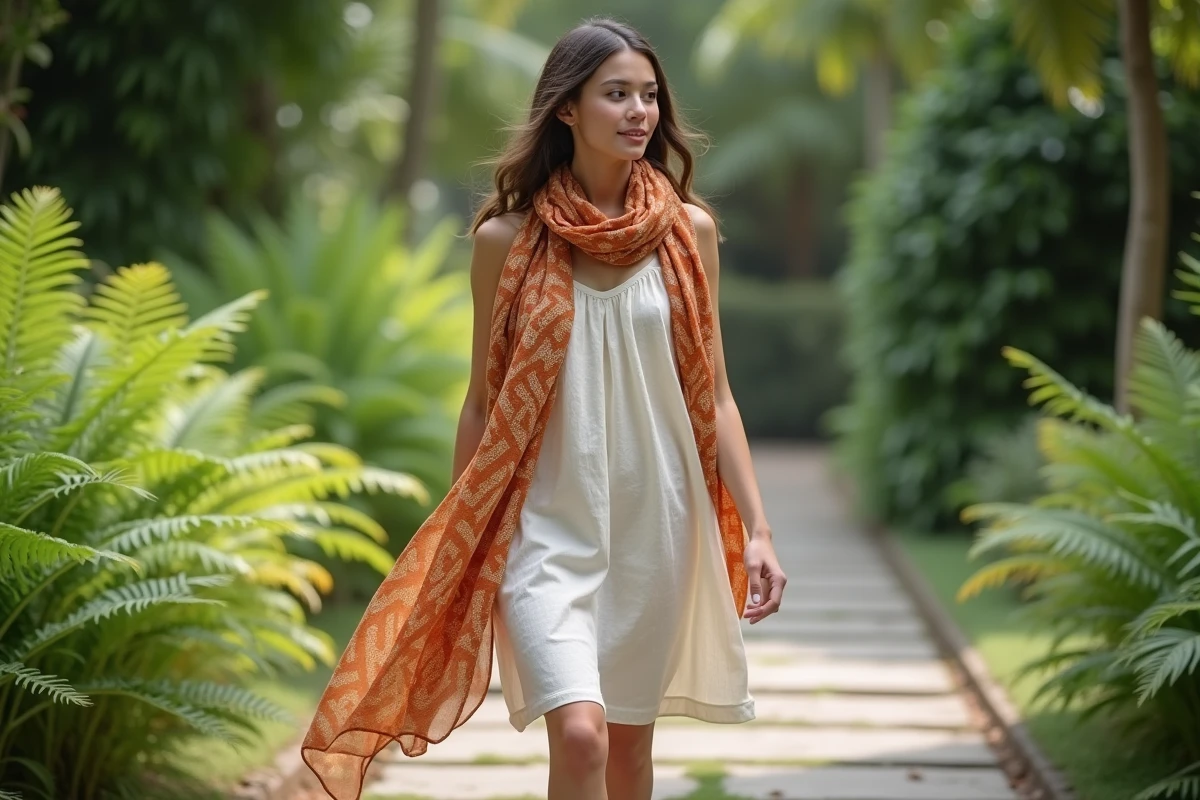
Color and contrast of the scarf on a dress: associations that work
The choice of scarf color follows a principle of controlled contrast rather than an exact match. A tone-on-tone scarf with the dress goes unnoticed, negating its stylistic interest. A scarf too far removed on the color wheel creates a visual break at the neck.
The effective zone lies between these two extremes:
- On a black or navy dress, a muted warm-toned scarf (terracotta, burgundy, dusty rose) draws the eye towards the face without being garish.
- On a light or pastel dress, a more saturated scarf in the same color family (sky blue dress with cobalt blue scarf, for example) creates depth without interruption.
- Small patterned prints work better than large designs on a scarf worn around the neck, as the visible surface remains small and a wide pattern can be cut off randomly.
A patterned scarf on a solid dress almost always works, while the reverse (solid scarf on a printed dress) requires more caution as the scarf may appear out of place if its color does not pick up one of the tones in the dress’s pattern.
Silk scarf and dressed-up dress: outfit mistakes to avoid
Silk, the preferred material for an elegant scarf, has a technical flaw: it slips. On a formal dress worn at an event, a scarf that comes undone throughout the evening produces the opposite effect of what is desired.
Two practical solutions exist. The first involves securing the knot with a small safety pin hidden under the fold, which maintains the structure without damaging the fabric. The second uses a scarf ring (a ring, often made of metal or resin) through which both ends are passed: the ring prevents slipping and replaces the knot with an adjustable tightening point.
On an evening dress, the scarf benefits from remaining discreet. A small square, tied once with the ends tucked in, adds a touch of color without diverting attention from the dress’s cut. The scarf does not need to be large to make an impact. It is often the restraint in volume and placement that distinguishes a well-worn accessory from a superfluous addition.