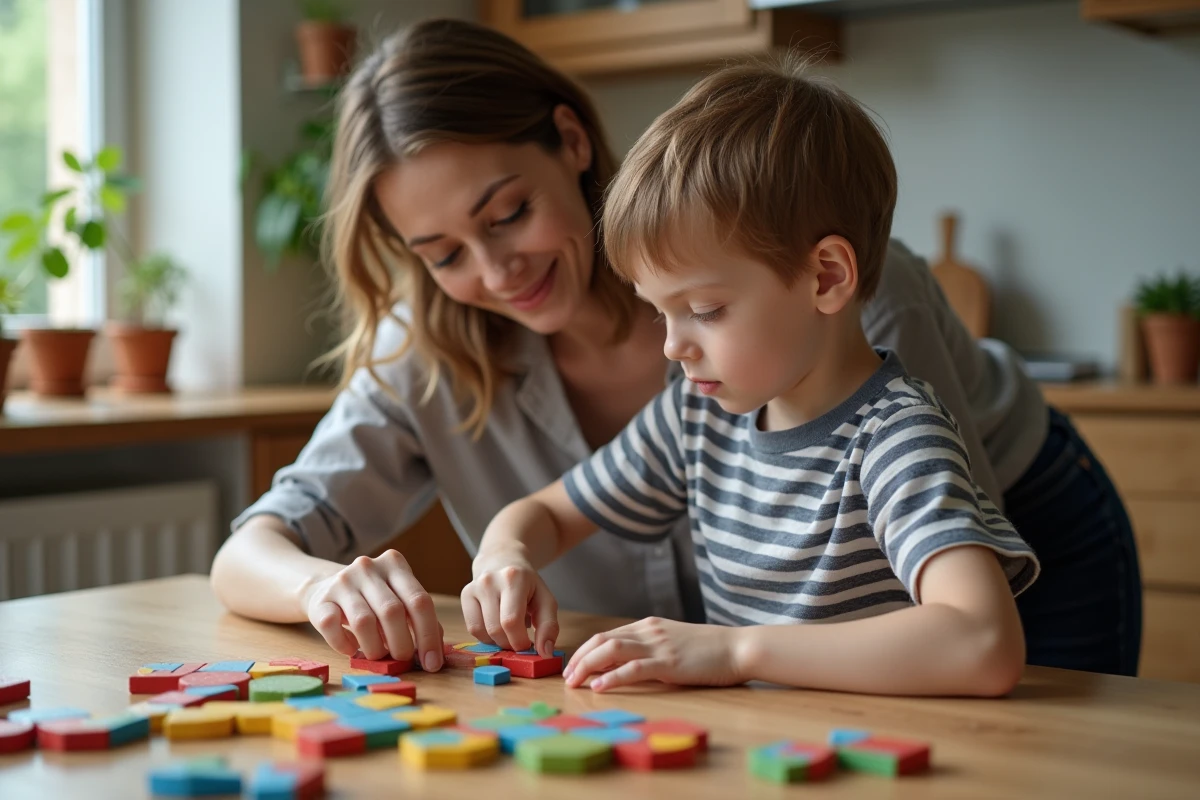
Supporting parents daily with their children requires distinguishing what truly works according to family contexts. The most widely shared parenting advice online targets a typical household (two parents, stable employment, child without particular difficulties). This framework overlooks a significant portion of families facing more complex realities.
General Parenting Advice and Specific Situations: What Standard Approaches Do Not Cover
The majority of guides aimed at parents structure their recommendations around routines, household organization, and time management. These areas are useful, but their effectiveness varies significantly from one household to another.
| Common Advice Type | Household with Two Parents | Single Parent | Child with Academic Difficulties |
|---|---|---|---|
| Structured morning/evening routines | Applicable (possible distribution) | Difficult without adult support | Can create tension if rigid |
| Delegation of tasks to the child | Gradual and supervised | Often accelerated by necessity | Risk of overload if the child is already struggling |
| Dedicated parent-child time | Possible alternation between parents | Limited by unique mental load | Priority but often sacrificed |
| Daily academic follow-up | Shareable | Relies on one adult | Requires appropriate support, not just time |
This table highlights a structural gap. The same advice produces very different effects depending on the family configuration. Single parents, for example, often lack the will but have limited room for maneuver.
To deepen your understanding of the resources available on parenting and its various dimensions, you can learn everything on the Bella Maman website, which addresses these topics from multiple angles.

Supporting a Child with Academic Struggles: Going Beyond Motivation Logic
The Minut’Rit raises a pertinent point by addressing school motivation and the fight against bullying. These two topics extend far beyond the realm of household organization tips.
A child who is disengaging from school does not respond to the same triggers as a child who is simply distracted. Academic distress calls for a relational response before any logistical solution.
Signals to Observe in the Child
- Sudden behavioral changes at home (withdrawal, aggression, sleep disturbances) without apparent cause in the family context
- Repeated refusal to talk about school or peers, associated with declining results
- Recurring somatic complaints (stomach aches, headaches) on school days, which disappear on weekends
In response to these signals, the parent’s attitude is as important as their actions. UNICEF emphasizes gentle parenting as a response to situations of real tension, whether it involves a crying baby or an angry teenager. This approach is not just about “staying calm”: it involves naming what the child is going through without minimizing or dramatizing.
Rephrasing what the child expresses (including through their behavior) is an underestimated lever. A parent who says, “I see that something is weighing on you right now,” opens a different space than one who asks, “Why aren’t you working at school?”
Parental Attitude and Formulation: The Impact of Language on Cooperation
A rarely addressed angle in parenting guides concerns how advice is formulated, including what parents say to their children. The Neoprofs forum has highlighted this issue: the way things are said alters the receptiveness of the listener, whether it’s a six-year-old or a teenager.
This observation also applies to professionals who support families. Advice perceived as judgment (“you should do this”) triggers resistance. The same content, framed as an observation (“some parents have noticed that…”), produces a different effect.
Formulations That Foster Daily Cooperation
With children, replacing an order with a description of the problem yields measurable results. “The door is left open” works better than “close the door.” The child’s brain processes the first sentence as information, the second as a constraint.
This mechanism intensifies during adolescence. Short, descriptive exchanges reduce tensions where long explanatory speeches provoke attention drop-off. Parents who adopt this posture do not provide “less education”: they adjust the communication channel.

Single Parent and Task Management: Adapting Advice to Household Reality
Single parents develop organizational strategies that classic guides do not document, as they arise from constraints absent in two-parent households. The mental load is not shared: it rests entirely on one adult.
Prioritizing rather than optimizing is the fundamental difference. A single parent trying to apply all standard recommendations (meticulous routines, daily educational activities, thorough academic follow-up) risks burnout.
- Identify two or three educational priorities each week rather than aiming for daily completeness
- Accept that some household tasks can be delegated to the child according to their age, without guilt related to an unrealistic parenting ideal
- Mobilize a temporary support network (neighbors, other parents) rather than seeking permanent support that is hard to maintain
- Preserve a weekly time slot for oneself, even if short, as a condition for emotional availability for the child
On the other hand, digital family planning tools, often recommended, may not suit all profiles. For a single parent already overwhelmed by professional screens, a visible paper planner in the kitchen may sometimes be more effective than an app.
Parental support becomes more relevant when it starts from the actual situation of the household rather than a theoretical model. Families that combine single parenting, children’s academic difficulties, or relational tensions need adjustable guidelines, not additional lists of best practices. The most reliable criterion remains the parent’s ability to maintain a quality connection with their child, even if imperfect, even if intermittent.