
A cake that rises spectacularly in the oven, then collapses as soon as you open the door: the scenario is familiar. In most cases, the problem comes from an excess of baking powder. Too much baking powder in a cake does not make it rise better; on the contrary. The batter becomes saturated with carbon dioxide, the crumb cannot hold its structure, and the result oscillates between a crater and a bitter aftertaste.
Double-acting baking powder and overdosing: an unknown trap
Have you noticed that some packets of baking powder are labeled “double action”? These baking powders contain two different acids. The first reacts upon contact with the liquid in the batter. The second only activates with the heat of the oven.
With the correct dosage, this mechanism is an asset: the batter rises gradually, and the structure has time to solidify. With an overdose, the opposite happens. The batter receives too much gas at two distinct moments, without the gluten or starch network being able to keep up.
The cake rises excessively during the first few minutes, then collapses on itself. The resulting crumb is dense, irregular, sometimes sticky in the center. To better understand the consequences of too much baking powder in a cake, it is essential to keep in mind this phenomenon of double gas release that amplifies every dosage error.
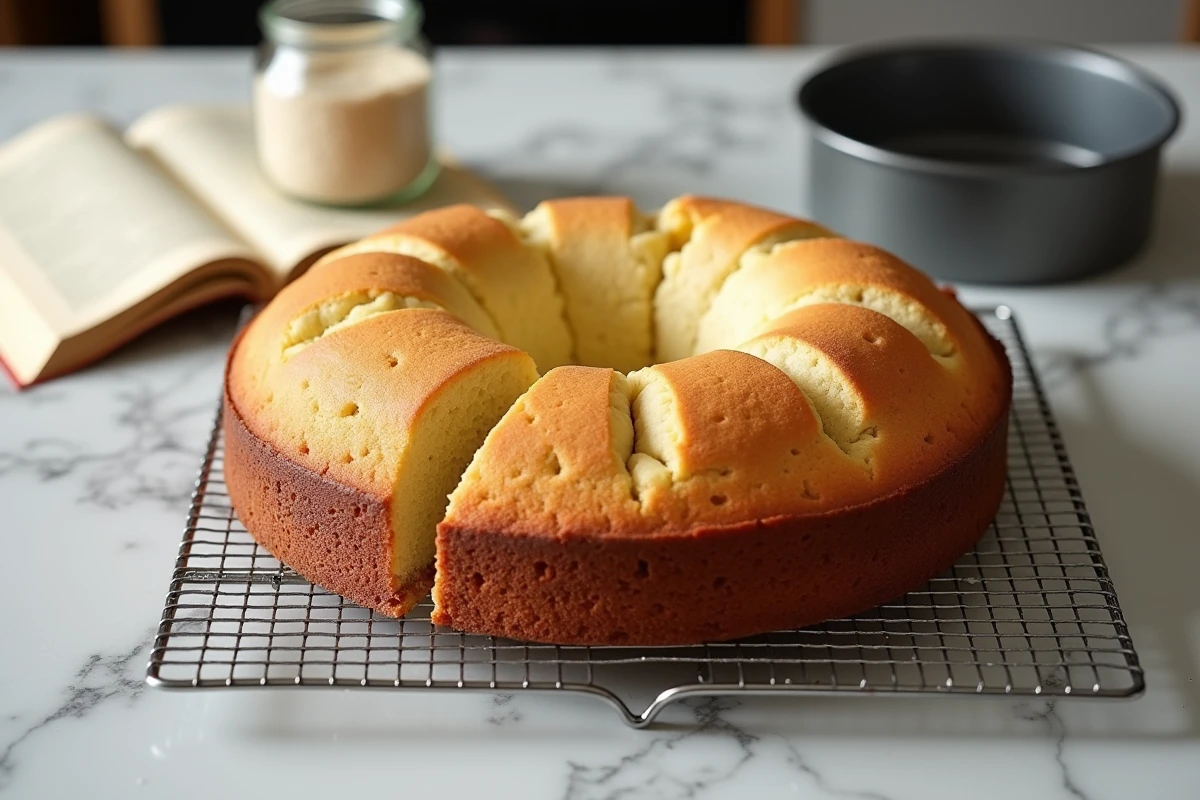
Chocolate cake and excess baking powder: the combination that worsens everything
Cocoa recipes deserve special attention. Cocoa powder is naturally acidic. However, baking powder contains a basic component (sodium bicarbonate) that reacts with the acids present in the batter.
When too much baking powder is added to a batter already rich in cocoa, the acid-base reaction goes into overdrive. The consequences are twofold:
- A pronounced metallic taste, linked to the excess of unneutralized bicarbonate, which persists even after baking.
- A crumbly and dry texture, because the surplus gas has weakened the crumb before it could set.
- A cake that cracks chaotically on the surface, very different from the beautiful crackling of a well-measured cake.
Chocolate cakes often require a little less baking powder than their vanilla counterparts, with the same mold size. This is counterintuitive, but the acidity of cocoa already does part of the rising work.
The role of the mold in the effects of baking powder overdose
A rarely mentioned parameter: the type of mold directly influences how an excess of baking powder manifests. Silicone molds, very popular for easy release, do not conduct heat as well from the bottom.
The bottom crust takes longer to form. Meanwhile, gas continues to accumulate in a still soft batter. A silicone mold amplifies the damage of an overdose because the cake’s structure does not have time to set before the gas escapes.
With a metal mold, heat reaches the center of the cake more quickly. The crumb solidifies in a few minutes, which limits (without eliminating) the effects of a slight excess of baking powder. If you regularly use silicone molds, the margin for error in baking powder dosage is simply thinner.
Baking powder dosage: concrete guidelines to avoid mistakes
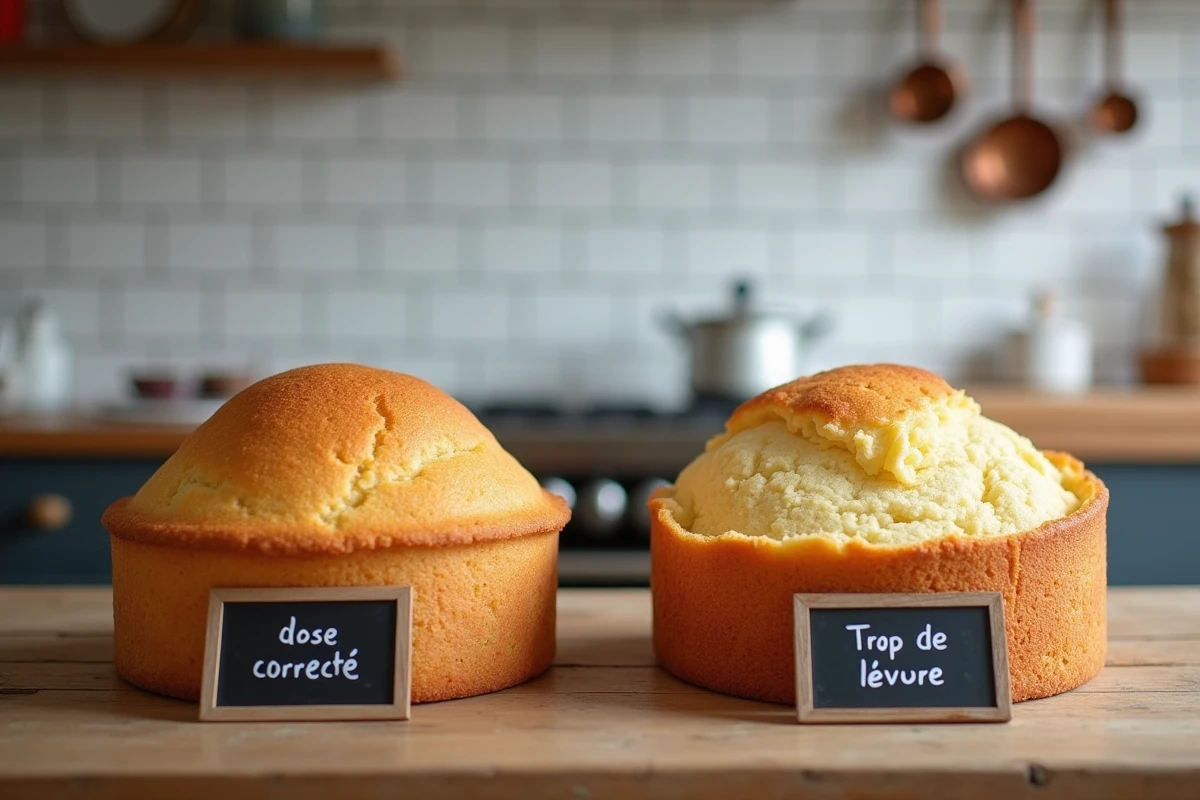
Most dosage errors come from a comprehensible reflex: “if one packet makes it rise, two packets will make it rise twice as well.” The chemical reality says otherwise. Beyond a certain threshold, adding baking powder only weakens the crumb.
Weigh rather than count packets
A standard packet of baking powder is not suitable for all quantities of flour. The scale is the only reliable tool. Teaspoons, “half-packets by eye,” and approximate pinches are the primary causes of overdosing in amateur baking.
Adjust the quantity to the recipe, not to the mold
Have you ever doubled a recipe to fill a larger mold? Double the ingredients, but not automatically the baking powder. The increase should remain proportional to the flour, and in the case of a large mold, the longer baking time allows more time for the gas to act. It’s better to stay slightly below.
The three signals of excess baking powder after baking
- The cake has risen and then collapsed in the center, forming a visible dip.
- The crumb has large irregular bubbles instead of a fine and homogeneous structure.
- A bitter or soapy aftertaste lingers, even with sweet frosting.
If you spot these signals, the next batch will benefit from reducing the baking powder by a good third.
Rescuing a failed cake due to excess baking powder
The cake is baked, it looks bad, but it is not necessarily lost. If the crumb is simply collapsed without being raw in the center, there are a few options.
Cutting the most airy and regular parts to make the base of a trifle or tiramisu works well. The soaking syrup and cream mask the metallic aftertaste. A failed cake recycles better when crumbled than when served whole.
On the other hand, if the center remains doughy and the bitter taste dominates, it’s better to start over. Flour and eggs are cheaper than a dessert that no one will finish.
The dosage of baking powder remains one of the simplest gestures to correct in baking. A scale, strict adherence to the recipe, and consideration of the type of mold are enough to eliminate the vast majority of failures. The packet of baking powder is not a rising accelerator; it is a chemical reagent that requires precision.