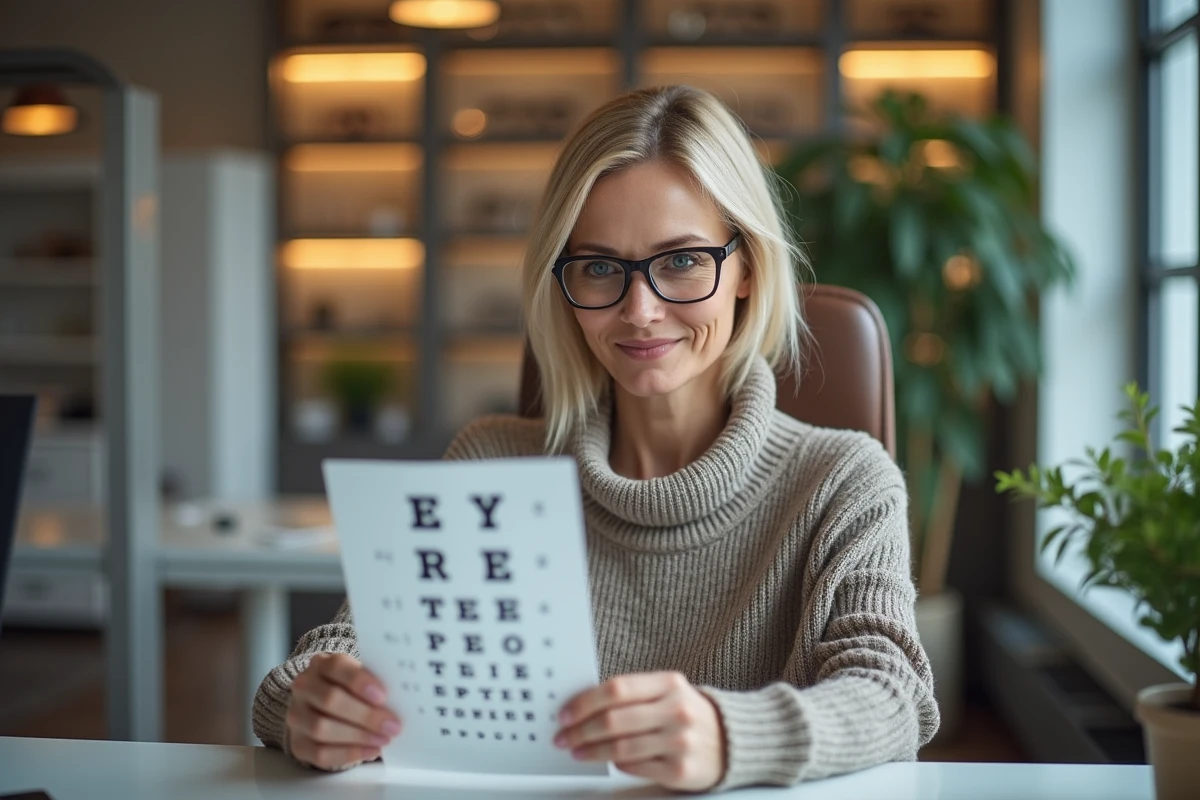
A visual acuity result of 5/10 is sufficient to obtain or renew a driver’s license in France, but such a measure does not guarantee optimal vision. The criteria vary by country and professional uses, while a single threshold applies in most common administrative procedures.
The value displayed during a test depends on both the method used and the reference standards, which can make comparisons misleading at times. The consequences of reduced acuity extend beyond simply reading letters on a board.
Visual acuity 5/10: what these numbers really reveal about your vision
Behind a measure of visual acuity lies much more than a cold number. We are talking here about a very concrete way of perceiving the world, of grasping or losing track of details. With an acuity of 5/10, clarity diminishes: where a person with “normal” vision can decipher at 10 meters, you will need to get closer to 5 meters to see as clearly. This seemingly innocuous medical statistic shapes daily life much more than one might imagine.
The causes of reduced visual acuity are varied: myopia, hyperopia, astigmatism, presbyopia, aging, more or less severe eye disorders. However, expressing acuity in tenths says nothing about the visual field, contrast, or how colors appear before your eyes. Reaching the threshold of 5/10, sufficient for driving in France, does not guarantee that every situation in daily life will be clear or comfortable.
The reality behind this number is often complex. Whether the impairment affects only one eye, whether it is corrected or not, or whether it is accompanied by another deficiency, everything can change. To go further, the article visual acuity 5 10 on Compar Santé details how this diagnosis influences daily life and why it cannot be taken lightly. This analysis helps to target the appropriate correction and anticipate a possible transition to visual impairment.
Visual acuity is never isolated. Age, eye health, type of ametropia, brain’s adaptability: everything intertwines to shape how we perceive and navigate space. Questioning acuity is to be interested in how each person reads, anticipates, and reacts to their immediate environment.
How is visual acuity measured and what methods are used by professionals?
To assess visual acuity measurement, specialists use standardized tests conducted under precise conditions. The goal: to determine at what distance the eyes can distinguish a shape, a letter, a symbol. For adults, the reference is generally six meters. For children, the distance is adapted, but the principle remains: measuring the ability to perceive details.
The most common method relies on reading letters or symbols of decreasing size, displayed on a board or projected on a screen. This is known as the Monoyer test or the Snellen scale: acuity is then expressed in tenths. Achieving 5/10 means seeing at five meters what standard vision detects at ten.
Other tools complement this overview; here are the most commonly used:
- The Armaignac test, designed for children or those who cannot read, featuring drawings or simple shapes.
- The examination under correction, using glasses or contact lenses, to determine the maximum visual potential after optical adaptation.
- The measurement of optical power (in diopters) to quantify a refractive disorder: myopia, hyperopia, astigmatism, presbyopia.
The resolution of the eye also depends on contrast, ambient light, and the health of the retina. Today, refractive surgery is developing to allow individuals to free themselves from external corrections. But regardless of the method, each eye must always be tested separately, then together, to obtain an accurate picture of visual capabilities in real life.
Why visual acuity is essential in daily life, especially for driving
The visual field conditions every action, sometimes without us realizing it. Reading a manual, recognizing a silhouette from afar, crossing a pedestrian crossing: each gesture relies on the sharpness of sight. Behind the wheel, the stakes become higher. The highway code requires a minimum visual acuity of 5/10 in the best eye, whether or not one wears correction. Falling below this threshold means losing the right to drive, without exception.
Ophthalmologists emphasize the need for regular vision checks. A blurry vision, even slight, makes the road riskier, reduces the perception of dangers, and lengthens reaction time. Wearing an appropriate optical correction, whether glasses or contact lenses, becomes essential to meet regulatory standards. But the issue is not limited to central vision: the peripheral vision field, which captures a pedestrian or a car approaching from the side, is equally crucial.
The 5/10 threshold set in France is not arbitrary. It corresponds to the ability to decipher signs, spot traffic lights, and distinguish movements at a reasonable distance to ensure everyone’s safety. In practical terms, every driver must ensure that their glasses or contact lenses are up to date, report any changes in vision to the authorities, and comply with current regulations. Vigilance does not stop at obtaining a license: it is required throughout the years, as vision evolves.
The road does not forgive approximation. On the asphalt or in the street, visual acuity draws the line between anticipation and uncertainty. This is where the world becomes clearer or fades away, one letter, one face, one signal at a time.